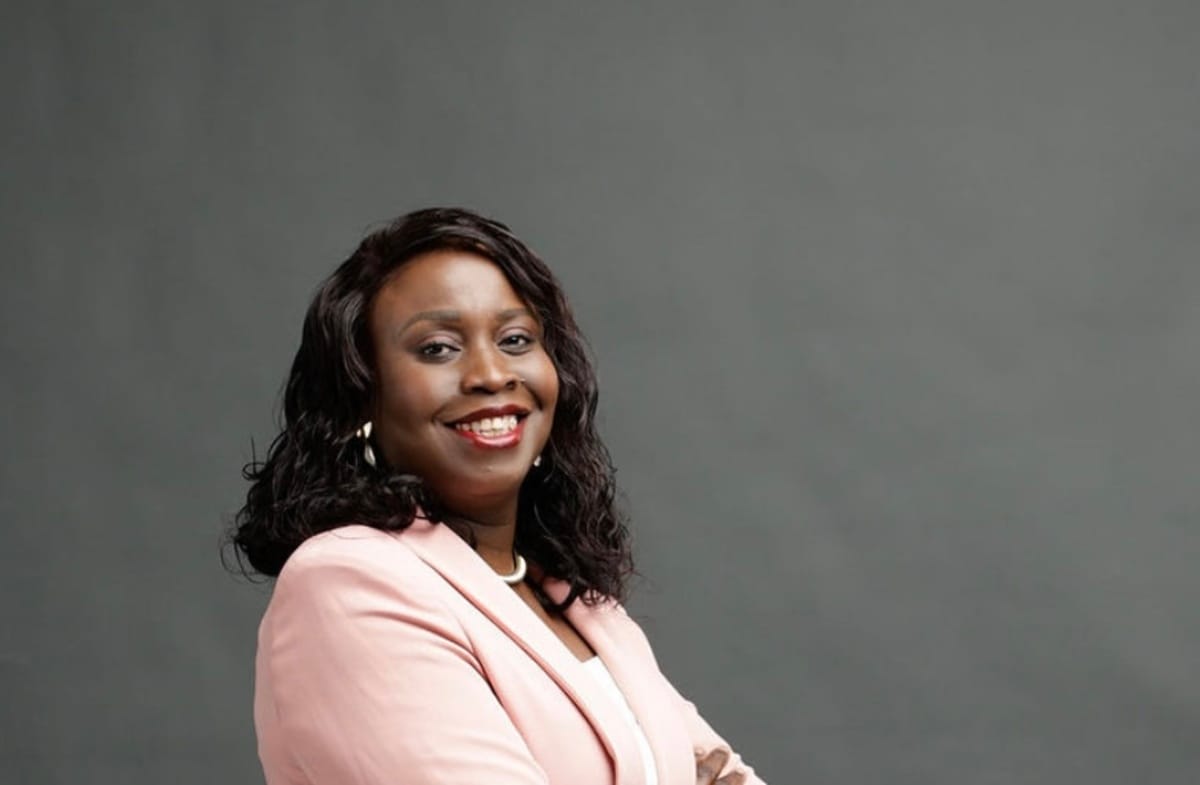
I recently contributed to a report on media viability in East Africa, covering Kenya, Ethiopia, and Uganda.
The report commissioned by RNW Media examined how public-interest media in the region are navigating both the editorial and structural challenges in the industry.
How do you sustain quality journalism when civic space is shrinking, regulations are tightening, and funding is increasingly uncertain?
The full report is worth reading if you're interested in how public interest media are navigating this moment. You don’t have to be from East Africa, because a lot of what's happening there has lessons for media everywhere.
INNOVATION IN ACTION

Generative AI journalism’s Titilope Fadare
AT A GLANCE
Who: Titilope Fadare, Nigerian journalist and AI trainer.
What: Generative AI Journalism, a practical training programme teaching Nigerian journalists to use AI tools without losing their editorial judgment or ethics.
The Problem: Many African journalists see AI as too technical, a threat to their jobs, or a shortcut that undermines “real journalism.” Without training, newsrooms risk being left behind - again.
The Innovation: Fadare skips the jargon and goes straight to the tools. Live demos, step-by-step walkthroughs, YouTube tutorials — all built around practical use cases journalists actually face, from analysing election datasets to handling confidential investigations safely.
Why It Matters: Fadare argues that AI literacy, verification, and prompting are now core journalism competencies. And she’s making the case that African creators and journalists don’t have to wait for tools built for them: they can use what exists to tell their own stories, on their own terms.
GO DEEP.👇🏾
When Titilope Fadare first started talking to Nigerian journalists about AI, the reaction was often either skepticism or fear.
So last July, she began what she calls “Generative AI Journalism”- a training programme aimed at showing journalists that AI isn’t as scary or complicated as they think, and that learning to use it might actually future-proof their careers rather than cost them.
Since then, she has trained newsrooms across Nigeria, both in person and online. The sessions are deliberately practical. “There are no abstract discussions about machine learning or neural networks. Just: here’s a tool, here’s how it works, here’s why it might help you”, she says.
I spoke with her about what she’s learned from working with journalists who might be skeptical or overwhelmed by AI.
Where It Started
Fadare’s interest in AI grew out of her earlier work training journalists in mobile reporting.
She’d been part of a Facebook-supported programme in 2020 that trained African journalists on how to use their mobile phones to tell stories.
Later, during her master’s programme, she came across ChatGPT. Out of curiosity, she tested it on an assignment, something she now admits, with a laugh, she wouldn’t recommend, but wanted to see what it could do. She says that while it helped with structure, it also cited false sources. That experience prompted a broader question: if AI could assist with research and organisation, what role might it play in a newsroom?
Her master’s thesis went on to examine AI adoption within the Nigerian Union of Journalists in Abuja. Alongside this, she began testing AI tools weekly, creating tutorials, and posting them on YouTube and social media to show journalists how to use them.
The Fears
What are some of the fears journalists express during training?
She says, three concerns come up repeatedly. The first is that AI feels too technical. “The language is an issue as journalists see all the jargon like machine learning, large language models, neural networks, and assume it’s beyond them, before they’ve even tried it.”
But when she walks them through a tool step by step, many realise it’s simpler than they thought.
The second is a question of legitimacy. Some fear that using AI isn’t “real journalism”; She says, “Some strongly believe that if you’re relying on a tool, you’re somehow cheating or cutting corners.”
“But I always remind them that AI doesn’t replace core journalism, it’s a tool that speeds up certain tasks like going through hundreds of documents, which would otherwise have taken you hours”, she says. “So you’re still doing the journalism.”
The third concern is job security. “Some think that AI will replace journalists entirely, but I tell them that AI won’t take your job, but someone who knows how to use AI will have a better advantage.”
Fadare draws a comparison with the shift from print journalism to digital. Imagine a newsroom saying, “We’ve always done print, our readers love print, so we are not using the internet.” She adds, “Audiences don’t wait, they move on, and it’s the newsrooms that refused to embrace new technologies that got left behind.”
How She Teaches
What sets Fadare apart is that she doesn’t teach AI as an abstract concept; she demonstrates it, step by step, with practical examples. In one tutorial, she demonstrated how Google’s Gemini could analyse an election dataset in real time. That way, journalists could immediately see how it might help them.
Ethics and Responsibility
One area she says she emphasises is around ethics, which is also a major concern for journalists. She advises journalists to be cautious about privacy and data security: don’t sign in to AI tools you’re unsure about using your personal or office email. “Assume that anything you give to AI could become public. So if you’re working on a confidential investigation, don’t feed that into a tool.”
She also encourages transparency: “If AI helped you summarise, redraft, or generate something, say so. People should know the source of the information, because credibility and trust matter.”
And then there’s bias. Many AI tools are developed in the West, so they often reflect Western contexts and sometimes biases. If you ask an AI tool to create an image of a scientist, it will often generate an image of a white male scientist.“ Rarely a woman. Almost never a Black woman.” For Fadare, this means journalists must actively share prompts that not only promote inclusivity but also reflect African realities.
What Makes It Exciting in Africa
What Fadare finds most exciting is that people are becoming curious. They see their peers using AI and want to know how it works. Some reach out with questions: “I have this problem. How can I fix it with AI?”
She says more creators and journalists are experimenting with AI to tell African stories in new ways, particularly on platforms like TikTok and YouTube. People are using AI generated images and videos to create animations and cartoons that would have been too time-consuming or expensive to produce manually. “For a long time, those kinds of productions came from outside Africa; now, African creators are telling their own stories, in their own way, without reinforcing stereotypes.
According to Fadare, “AI is also levelling the playing field; people who couldn’t previously produce videos or edit podcasts can now create explainers or edit audio with AI. You don’t need advanced technical skills anymore, and that’s what makes it exciting.”
What Journalists Need to Learn
Fadare believes journalists today need three essential skills.
The first is AI literacy, basically understanding what AI is, how it works, where it fails, and where bias comes from.
The second is verification. AI has made deepfakes easier to create. There is so much AI-generated content that is so convincing, so journalists need to improve their ability to distinguish what’s real from what’s not. “We’re now in an age where we use technology to fact-check technology,” she says.
Third is prompting. “The quality of an AI’s output depends heavily on the instructions it was given. “You can’t just type a few words and expect to get a perfect result,” she says,
“Learning how to prompt properly is now an important skill.”
A Shift in Mindset
I ask if she’s encountered any resistance. She says it remains, particularly among those concerned about job losses or declining standards. But Fadare is quick to add that their attitudes often change once they see the tools in action. “The change usually happens when they use the tool themselves and realise that AI assists, but doesn’t replace their judgment, reporting, or ethics”, she says.
That’s the message Titilope hopes will stick: that AI is a tool, and like any tool, its value will depend on how it is used, so it will not replace your judgment as a journalist.
🚀OPPORTUNITIES WORTH KNOWING
The good stuff: upcoming events, grants, training programs, jobs, and more
INMA 30 Under 30 Awards 2026
INMA's 30 Under 30 Awards recognise five outstanding individuals across six global communities (Advertising, Data, Management, Editorial Leadership, Product, and Reader Revenue)
Deadline: 19 June 2026.
Pulitzer Center — Underreported Stories in Africa Grant
The Pulitzer Center accepts grant proposals on a rolling basis from journalists and newsrooms around the world, with proposals focused on Africa covering issues including water and sanitation, land degradation, education, maternal health, and climate resilience, and strongly encourages proposals from journalists representing underrepresented social, racial, and ethnic groups. Most awards for international travel are between $5,000 and $10,000, though amounts may vary depending on the project.
Mongabay Global — Video Pitches (Environmental Journalism)
A paid commissioning opportunity for video journalists covering climate and environmental stories. Mongabay is accepting pitches in two formats: features of 5–6 minutes (solutions-oriented, character-led short documentaries centred on communities impacted by environmental change) and short news clips of 1–3 minutes produced for social media in vertical format.
This Issue Brought to You By Reebo Consult
We work with media organisations to turn big ideas into real impact — integrating AI, navigating digital shifts, and rethinking editorial strategy for the future. Curious about what that could look like for you? Let’s connect. Send me an email.
Help us keep sharing real stories
▶ Know someone who’d love this? Forward it their way.
▶ Was this email forwarded to you?